 RubySquare
A workout disguised as a game
Rotating colored blocks looks simple. Underneath, every move trains the same mental muscles used in spatial reasoning tests.
Spatial IQ
Mental rotation is one of the strongest measured predictors of spatial reasoning ability.
Board vision
Reading a scrambled 6x6 grid at a glance is a skill you build level by level.
Pattern recallHand-tuned levels across eight stages, from gentle warm-ups to genuine monsters.
Squares on the largest boards — enough room for real chaos and real satisfaction.
Working memory
Holding the target pattern in mind while you rotate is quiet training for short-term recall.
Deep focus
Fourteen uninterrupted minutes on a hard board beats an hour of doom-scrolling.
Remember. Rotate. Resolve.
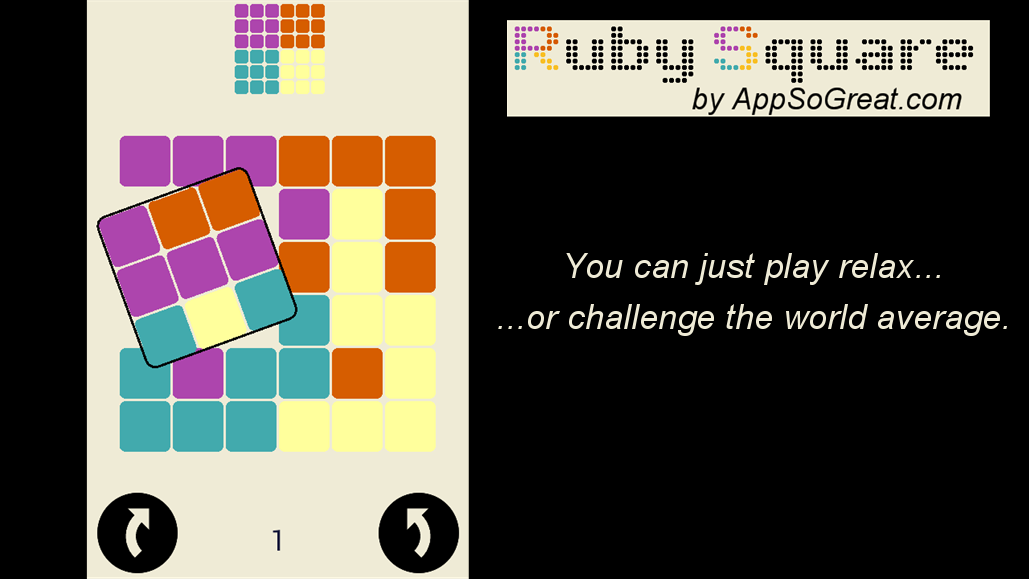
One rule drives everything: spin 2x2, 3x3 or 4x4 blocks until your board mirrors the target. The depth comes from doing it in as few moves as possible.
Study the target
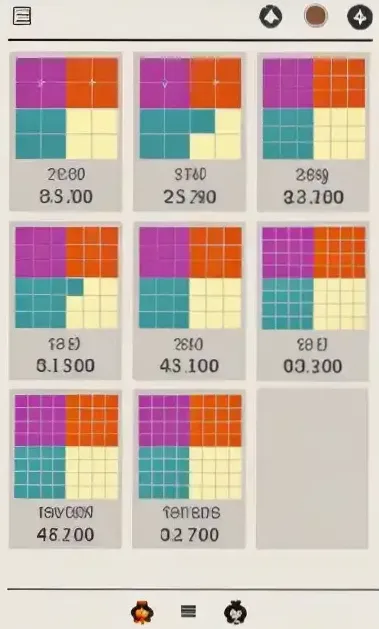
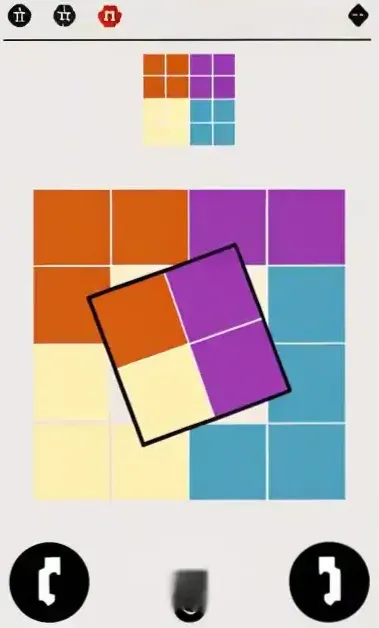
Every level opens with a small target pattern beside a scrambled board. Memorize it — the whole puzzle is the distance between what you see and what you need.
Rotate a block
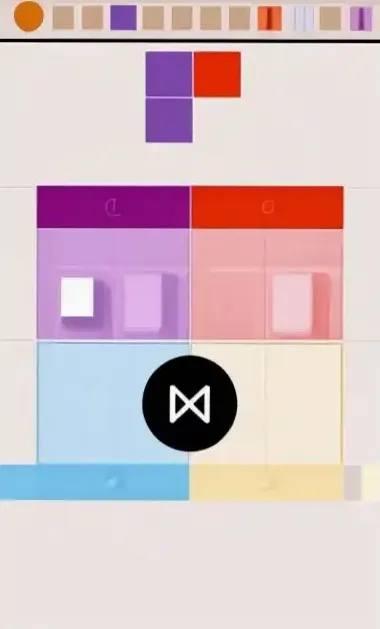
Tap any block of squares to spin it 90 degrees. Rotations ripple across the board, so each move rewrites several cells at once. One tap can fix four squares — or ruin a nearly finished corner.
Match the pattern
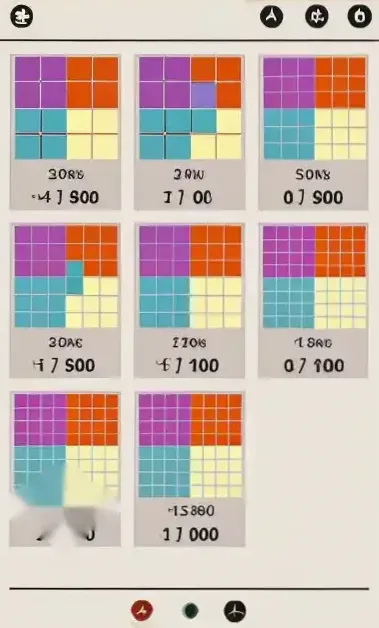
When your board mirrors the target exactly, the level completes. Your move count is compared against the world average — the quiet scoreboard that keeps perfectionists coming back.
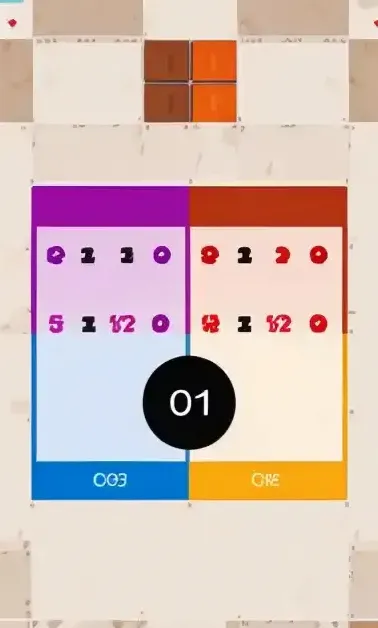
Undo freely, retry endlessly
Made a bad rotation? Undo is one tap. Stuck entirely? Restart costs nothing. The game wants you thinking, not rationing attempts — a philosophy we expand on in our story.
Anatomy of a rotation
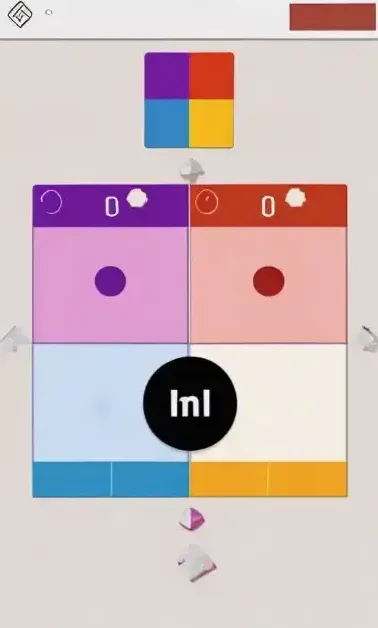
Choose a block size and watch how a single tap reshapes the board. Bigger blocks move more squares — and demand more foresight.
2x2 — the scalpel
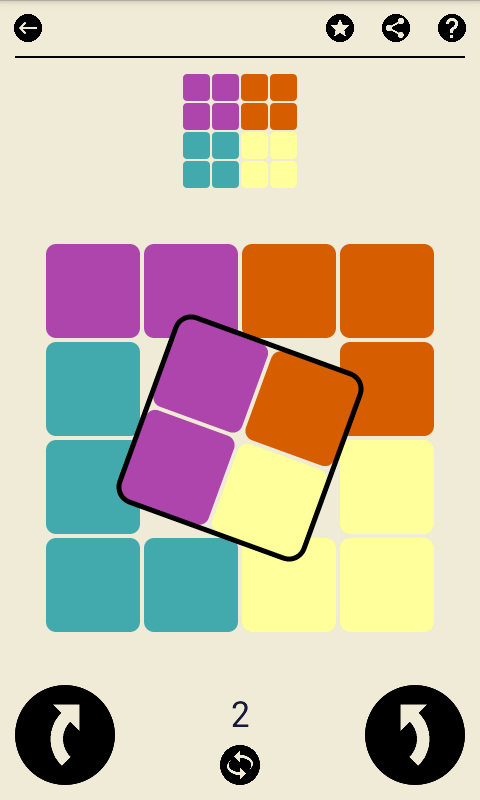
Four squares per rotation. Surgical, predictable, and the first language every player learns. Most early levels are solvable in under a dozen 2x2 turns.
- Introduced from level 1
- Minimal board disruption per tap
- Best for corner corrections
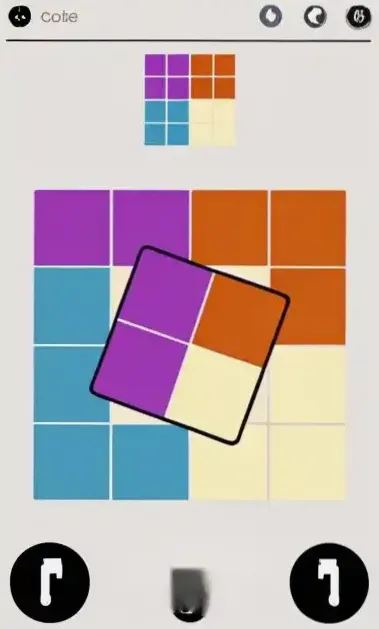
3x3 — the workhorse
Nine squares move at once, so each tap is a small gamble. Medium-stage levels live here: readable enough to plan, big enough to punish haste.
- Core of the Medium and Hard stages
- Rewards 2–3 moves of lookahead
- The world average starts to bite
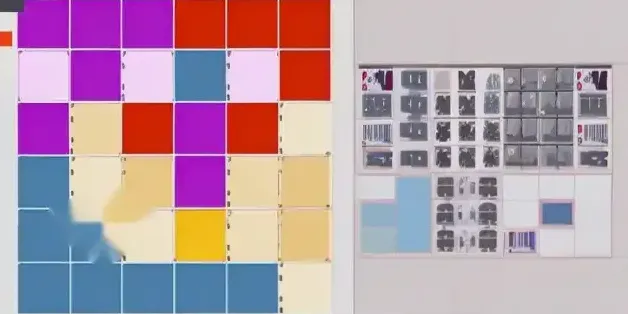
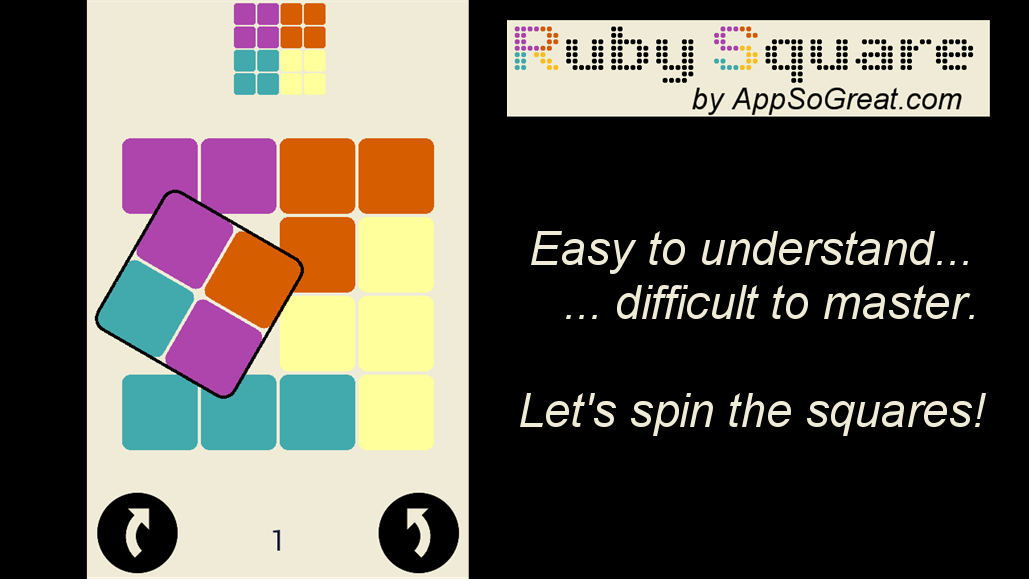
4x4 — the avalanche
Sixteen squares per tap. One optimistic rotation can undo five careful ones — this is where Extreme-stage reputations are made and broken.
- Reserved for Hard and Extreme stages
- Demands full-board planning
- Home of the lowest move records
Fifteen minutes that compound
Players who treat Ruby Square like a daily warmup — not a binge — report the biggest gains in board vision. Three natural slots fit almost any schedule.
Two easy levels with coffee
Short 3x3 boards wake up pattern recall without demanding heroics. Most players clear both before the kettle finishes.
One medium board, full attention
A single Hard-stage puzzle is a clean mental break between tasks — absorbing enough to clear your head, short enough to return on time.
The Extreme board you've been circling
Evenings are for the level that beat you yesterday. Dark theme on, phone face down between moves, and the slow satisfaction of a plan coming together.
Your month in levels
How many puzzles would you clear at your pace?
4 levels a daylevels per month
of focused play
Weekly Pattern #409
Every week one Extreme-stage board becomes the community's shared obsession. Solve it below the world average to make the board.
Katya M.
14 moves
Dev P.
11 moves
Rui S.
16 moves
Chasing the board
17 moves on attempt twelve. "I stopped counting rotations and started reading the corners instead — the whole board opened up."
18 moves, all solved on a metro ride. "The cross method from the pattern-reading guide saved me four moves."
19 moves. "I rotate the board in my head before touching the screen now. Slower start, faster finish."
From novice to cryptographer
Eight stages, 700+ boards. Each pack tightens the screws a little more — bigger grids, more colors, harsher par scores.
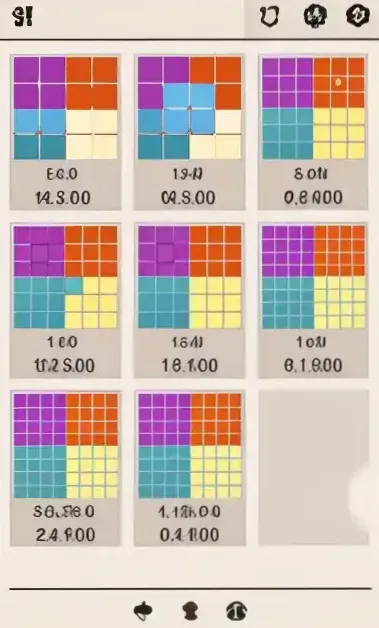
First Squares & Foundations
Small boards, two or three colors, generous par. This is where your fingers learn what your eyes already suspect — and where most players finish their first hundred levels without noticing the time.
- Levels
- ~150
- Board sizes
- 16–25 squares
- Avg. solve
- Under 3 minutes
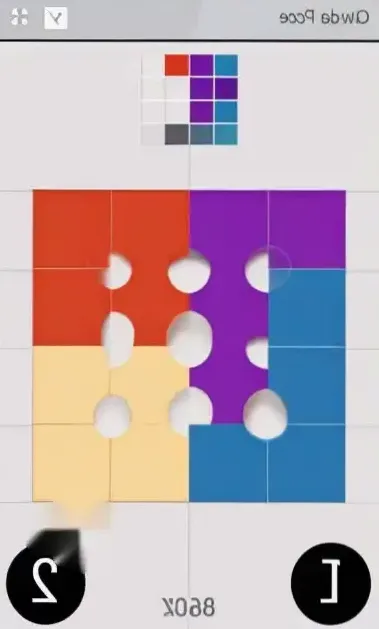
Colorfields & Crossroads
Four colors enter the palette and 3x3 rotations become the default. Patterns stop being obvious; you start solving in quadrants instead of cells.
- Levels
- ~200
- Board sizes
- 25–36 squares
- Avg. solve
- 4–8 minutes
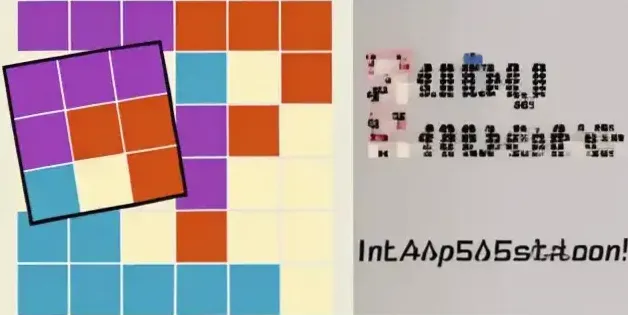
Deep Patterns & Edge Cases
Five colors, 4x4 blocks, and par scores that assume you've internalized the cross method. Finishing a stage here puts you well past casual.
- Levels
- ~200
- Board sizes
- 36–49 squares
- Avg. solve
- 10–15 minutes
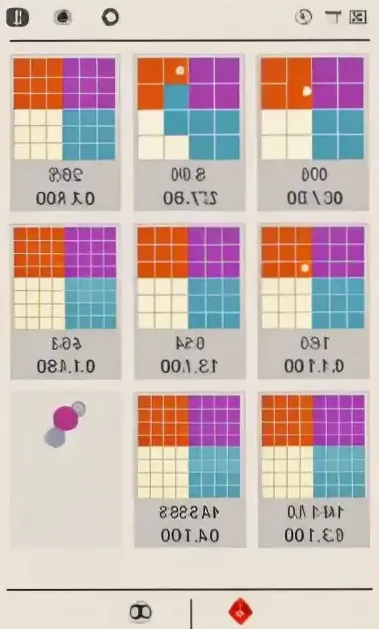
The Ruby Vault
Sixty-four squares, six colors, and boards that look like static until the structure suddenly reveals itself. The final 150 levels are the reason this page exists.
- Levels
- ~150
- Board sizes
- 49–64 squares
- Avg. solve
- 20+ minutes
Could you solve this in two moves?
A taste of the real thing. Compare the scrambled board to the target — most people need a screenshot and a quiet room.
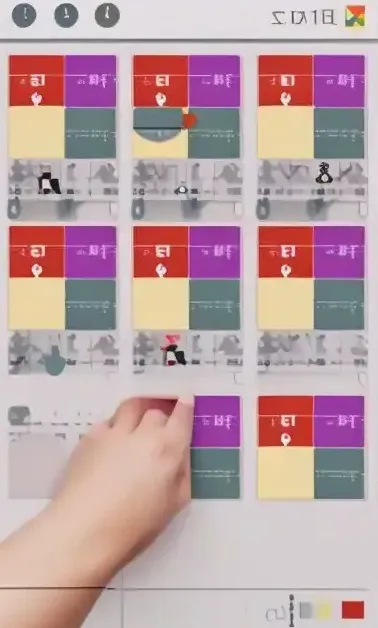
Which rotations get you there?
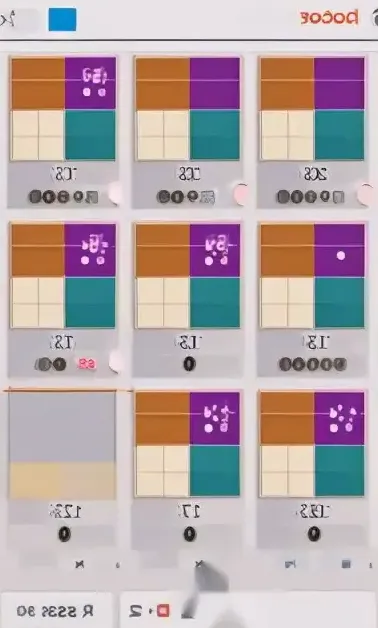
If your answer involved "rotate the center 3x3 twice", congratulations — you're thinking like the game. The full diagnostic waits inside.
Test yourself in the appWhat solvers actually say
"Downloaded for a flight, still playing three months later. The move counter vs. world average is the meanest, best feature — I replay levels just to shave off one more tap."
"Finally a puzzle game that doesn't scream at me. No timers, no energy bars, no 'watch an ad to continue'. Just me versus the board."
"The colorblind palette is the first one I've used that doesn't feel like a compromise."
"Extreme stage humbled me for a week. Then level 6x6-41 clicked and I yelled on the train."
"My kids fight over the Easy stages. I'm on Hard. It scales to whoever's holding the phone."
A good puzzle doesn't entertain you — it reorganizes you. Ruby Square compresses the pleasure of a Rubik's Cube into a flat board you can read at a glance, then asks the only question that matters: can you see it before you touch it?
Memory before motion
The target pattern is small enough to memorize and complex enough to forget. That tension is the exercise.
Constraint breeds clarity
No timers, no lives, no energy. The only pressure is the par score — and it's optional.
Depth over decoration
Every pixel earns its place. When a game looks this calm, the thinking gets loud.
"We wanted the eureka of the cube without the arthritis of the cube."— AppSoGreat, design notes
Pure puzzle, zero paywalls
All 700+ levels are playable for free. The premium upgrade exists for one reason: you want the ads gone and the studio supported.
The full board
- All 700+ levels across 8 stages
- World-average move comparison
- Colorblind palettes & dark theme
- Cloud save via Google Play Games
Ad-free, forever
- Zero ads on the game screen
- Full-screen board, no distractions
- Direct support for a two-person studio
- One coffee, once — about A$1
Payments are handled entirely by Google Play billing — we never see your card details. Refund policy
That satisfying click
Three frames of the moment every Ruby Square player chases: nearly there, the final rotation, and the board snapping into perfect order.
01 — Nearly there. Three squares wrong. You can feel the answer circling.
02 — The final rotation. One tap, sixteen squares realign, and the pattern locks.
Victory flash
03 — The flash. Under the world average? That's a story you tell people about.
Numbers that keep us honest
A small game with a quiet, stubborn player base — here's the shape of it.
Puzzles solved worldwide — roughly one every 0.7 seconds while you read this.
Average Google Play rating across thousands of reviews and seven years of updates.
Countries with at least one active solver — the boards travel better than we do.
Figures verified against the public Google Play listing, October 2026.
Scan to rotate
Reading this on a laptop? Point your phone camera at the square and land straight on the Google Play page. On mobile already? One tap does the same job.
- Free to download, ~15 MB
- Runs on Android 4.4 and up
- Works fully offline once installed
Camera app → Google Play → Level 1
Sharpen your mind
today.
The board is already shuffled and waiting. Your first under-par solve is closer than you think.
Free download · ~15 MB · No account needed to start