 RubySquare
Hidden patterns & symmetry
Where the game's pattern language comes from.
How a 64-square board gets authored — the golden-ratio rules, the solvability checker, and why level 612 took eleven drafts.
Every level you've played started as a blank grid and a question: what should this board teach? That framing matters — a Ruby Square puzzle isn't a random scramble, it's a designed experience with a specific insight hidden inside it.
Here's the trick most players never think about: we don't design the scrambled state, we design the path. Every board begins solved. Then a designer un-plays it — rotating blocks away from the target with intent, building in the traps and the false shortcuts the player will later 'discover'.
A good board has a rhythm to its scramble: an obvious-looking opening that's actually a detour, a hidden anchor that rewards careful reading, one elegant mid-game insight. Difficulty is just how deeply those are buried.
Before a board ships, two gates: the solver engine verifies a solution exists within the move budget we intended, and a human — usually me — plays it cold, without the scramble history. If I can't feel the designed path, the board goes back. Level 612 went through eleven drafts before its insight clicked.
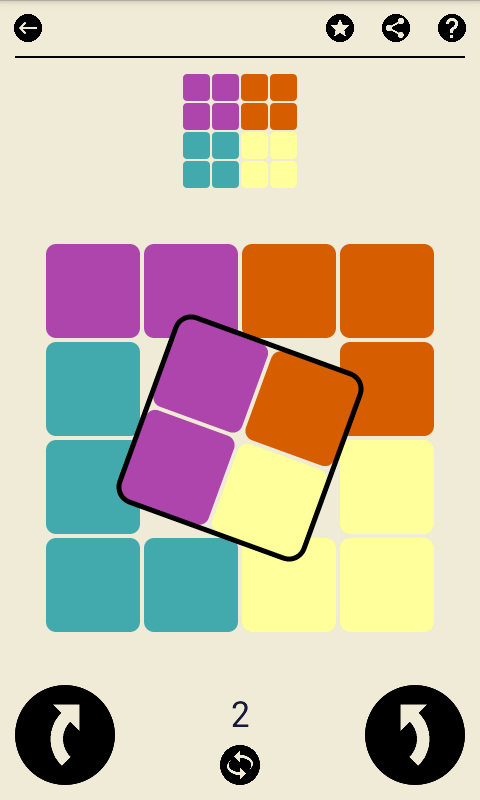
The layout itself follows boring-but-true rules: the target preview sits at 62% of the board width — close enough to compare, small enough to stay subordinate. Board cells use an 8-point grid; the gap between block borders is exactly one hairline. Players feel this precision without ever seeing it, which is the entire point.
A puzzle that shows its design is a tutorial. A puzzle that hides it is a discovery.
Boards are designed backward — the scramble encodes the traps and insights you'll discover.
An engine verifies solvability; a human verifies the board feels designed, not random.
62% target width, 8-pt cell grid, hairline borders — felt, never seen.
Lead puzzle designer, AppSoGreat
Maya designs the boards you love to hate. Seven years, 700+ levels, and she still solves every new pack by hand before it ships.